Commercial Dryer Vent Cleaning for Multifamily and Facility Laundry Systems
Commercial dryer vent cleaning removes lint and obstructions from the entire exhaust path serving a building’s dryers: the transition duct behind each machine, the branch leaving the unit, the shared or stacked riser those branches feed, any booster fan in the run, and the exterior termination. It is a building-scale job planned around occupied space, tenant access and work-order reporting, not a residential visit repeated per machine. We serve property managers, facility teams and laundry operators nationwide. Call (832) 777-5400 to scope a building.
Why a per-unit approach fails in a building
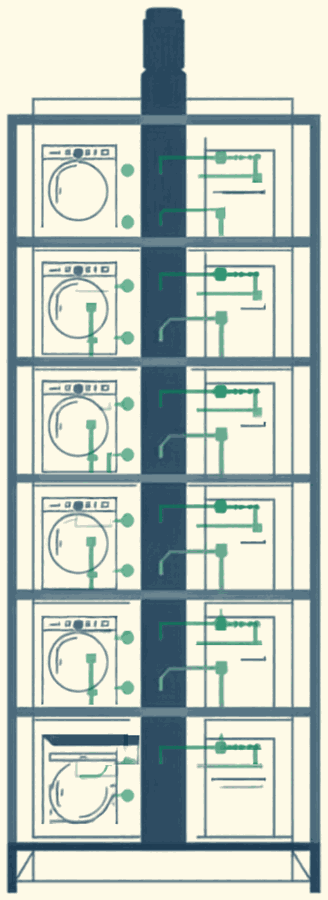
A single-family vent is short, private and independent. A building inverts that. The duct behind any machine is usually the shortest, least loaded segment, while what governs airflow — the riser, the long main, the roof or sidewall hood — is shared, concealed and outside any occupant’s control. Cleaning twelve connectors on twelve floors leaves the duct all twelve discharge into untouched.
The U.S. Fire Administration states that “Lint is a highly combustible material that can accumulate both in the dryer and in the dryer vent. Accumulated lint leads to reduced airflow and can pose a potential fire hazard.” A stacked riser is the longest, most bend-heavy run in a building.
Where lint collects in a shared system
Risers, common ducts and booster fans
Where several dryers discharge into one main, lint deposits unevenly: heaviest at elbows, offsets and diameter changes. Risers are reachable only at cleanouts, the roof cap or branch connections, so access drives the plan. Buildings with long runs often carry a booster fan, whose housing and wheel sit in the lint stream. USFA notes codes require “the total length of the vent duct not exceed 35 feet (shorter if there are turns or bends).”
Terminations, hoods and connectors
USFA reports blockage from bird or animal nests or from damage to the venting system, leaving a vent that cannot exhaust properly. Dampers need weather covers, but USFA warns against wire screen or cloth, which collect lint. At the machine, flexible plastic or foil connectors trap lint and crush easily; codes require transition ducts “not longer than eight feet, not concealed within construction, and listed and labeled in accordance with Underwriters Laboratories (UL) 2158A.”
What the fire data does and does not say
USFA reports that “Failure to clean (31%) was the leading factor contributing to the ignition of clothes dryer fires in homes from 2018-2020.” It outranks mechanical and electrical causes. But it describes homes — USFA’s dryer statistics are residential, not a measured commercial failure rate. What carries into a building is the mechanism, not the percentage. Nothing in this guidance links dryer venting to carbon monoxide, and we make no such claim; annual gas-dryer line inspection is separate, licensed work we route.
Scheduling around occupied space
Scheduling is usually harder than the cleaning. Common laundry rooms can be worked in sections so part stays in service, riser work is staged for low-use windows, and in-unit machines are grouped by stack so one notice covers a column. Site staff are the best early warning: USFA notes that items taking unusually long to dry, or clothes hotter than usual at cycle end, likely indicate a clogged exhaust.
Documentation and work-order reporting
For a property team the report is half the deliverable. Ours records what was cleaned, what could not be reached and why, connector and termination condition, and defects belonging to another trade, mapped to unit and stack. Verification is visual and photographic; EPA’s HVAC standard is that “you should not be able to detect any debris with the naked eye.”
Scope limits, stated up front
We clean and document dryer exhaust. We do not issue code compliance certification and we do not perform licensed fire-protection work. Code interpretation and sign-off rest with your authority having jurisdiction. Where our report shows a crushed connector, damaged hood, or run terminating in a concealed space — USFA notes venting into attics, soffits, ridge vents or crawl spaces is “expressly prohibited” — that finding is handed to you to route.
Related building services
Exhaust cleaning pairs with a scheduled dryer vent inspection to set an evidence-based interval, and with commercial air duct cleaning where the HVAC side is in scope. Leakage and disconnected sections are addressed under duct repair and sealing, and building distribution under HVAC duct cleaning. Building details go through our contact page.
Frequently asked questions
Who cleans dryer vents in an apartment or condo building?
In a multi-unit building the exhaust joins shared ductwork no resident controls, so the property manager, owner or facility team commissions the work, not a tenant. A residential service cleans one machine and the duct behind it. A building needs the branch, riser and termination treated as one system, with a written record for the work-order file.
How often should commercial dryer vents be cleaned?
There is no single federal number for buildings. The U.S. Fire Administration says the dryer interior and venting system should be serviced and cleaned periodically by qualified service personnel, especially when clothes take longer than normal to dry, and the Consumer Product Safety Commission likewise advises periodic vent and duct cleaning. The National Fire Protection Association suggests clearing the vent pipe about once a year. Set the interval from observed lint loading, not a calendar.
Why does cleaning each machine individually not fix a shared riser?
A shared riser collects exhaust from dryers on several floors or bays and carries it to one termination. Cleaning only the connector behind each machine leaves the riser loaded, so airflow improves briefly at the appliance while the restriction remains. USFA’s warning about long, bend-heavy runs applies most strongly here, because condensing moisture attracts lint.
Can the work be done without closing the laundry room?
Usually it is staged rather than done in one shutdown, so the laundry does not go offline in a single block. The staging approach is described above.
Do you certify that our dryer exhaust meets code?
No. We report what we found and what we could not reach; certification and sign-off rest with your authority having jurisdiction. Findings such as a crushed transition duct or damaged hood go to you to route.
Scope a building
Call (832) 777-5400 with machine counts, stack layout and termination locations.